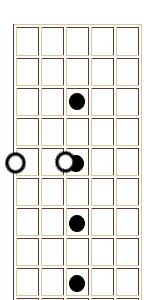
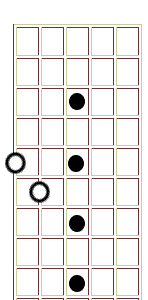
Intervals are the distance between 2 notes. Recognizing the sound of
different
intervals by ear is a key part of your development as a guitarist.
When you
hear a note, the ability to the know the pitch of any other note
from the previous
note is called "relative pitch". We've included several
ear training
exercises that will help you develop relative pitch, but first
you'll want
to learn your intervals.
Watch the "Intervals" video:
Whole Step and Half Step Intervals
Intervals are simply the distance between two notes. There
are 12 different
notes in music. Imagine them as blocks:
1
2
3
4
5
6
7
8
9
10
11
12
The distance between each note block is called a half step interval.
A half step interval on the guitar's fretboard is one fret. So the distance
between blocks 1 and 2 is a half step interval and the distance between
blocks 2 and 3 are a half step interval and so on...`
A whole step interval means you skip a note. A whole step
interval in
the guitar's fretboard is two frets. For example: the distance
between
the 1st note and the 3rd note is a whole step interval. The distance
between the 3rd note and the 5th is a whole step interval, etc.
See the
blocks below:
1
3
5
7
9
11
The intervals of the major scale (the distance between the notes)
are
used to describe these distances. Keep reading and I'll explain.
The Major Scale
You probablly remember singing the Do-Re-Mi song when you
were a kid,
if so you probablly already know the major scale,
because the Do-Re-Mi
song IS the major scale.
This is what the major scale sounds like in the key of C:
Sound familiar? It should. You've heard it in songs all your life.
The major scale is a pattern of 7 notes from the 12 different notes in
music.
You can construct the major scale by using this interval pattern:
whole step, whole step, half step, whole step, whole step, whole step,
half step.
This pattern is the formula for the major scale.
Look at the blocks below to see the intervals of the major scale.
The "WS" means whole step and the "HS" means half step.
WS
WS
HS
WS
WS
WS
HS
1
2
3
4
5
6
7
8
9
10
11
12
To construct a major scale in any key signature we simply start on the
note that is the same as the name of the key signature. For example to
construct the major scale in the key of C like in our audio example above,
we start on the note C and follow the formula. The C note would be our
first step in the scale. It can be also called the root note.
Every note in the major scale is given an interval name describing the
distance between it and the 1st step of the scale (the root note).
The second scale step is called a second. On the guitar it
is 2 frets from the root note.
The third scale step is called a major third. On the guitar
it is 4 frets from the root note.
The fourth scale step is called a fourth. On the guitar it
is 5 frets from the root note.
The fifth scale step is called a fifth. On the guitar it is
7 frets from the root note.
The sixth scale step is called a sixth. On the guitar it is
9 frets from the root note.
The seventh scale step is called a major seventh. On the guitar
it is 11 frets from the root note.
12 frets above the root note is the octave. From C to the next
C at a higher pitch is an octave. They are the same notes and sound
alike except they are at different pitches.
Here, take another listen as the C major scale is played in sequence
from the lowest note to the highest note and back down again. The note
at the "top" (the 8th note) is the octave of the first note.
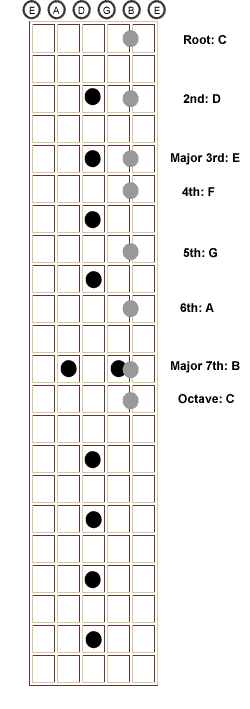
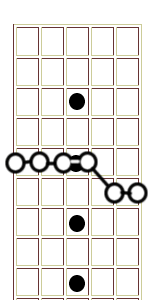
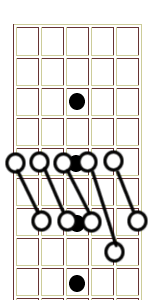
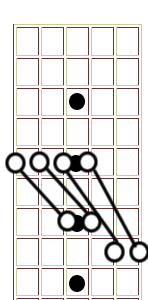
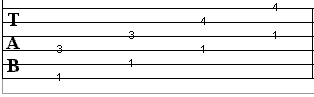
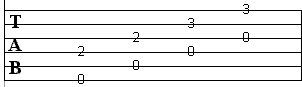
Here is how the notes line up on the fretboard by using the C note on
the 1st fret of the B string as our starting point:
Intervals can be extended above the octave, too.
Perfect Intervals
The distance between two notes is an interval. We use intervals to build scales
and chords, or for harmony parts.
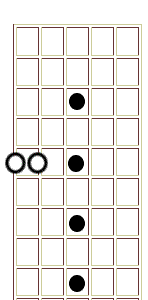
Unison
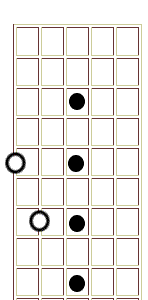
Octave
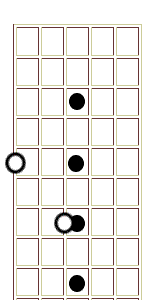
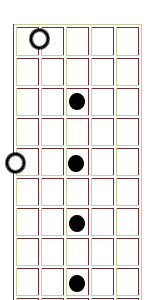
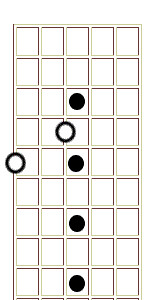
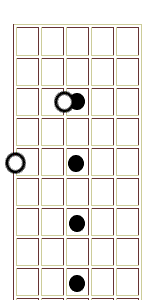
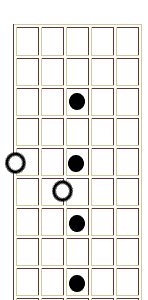
Perfect 4th
Perfect 5th
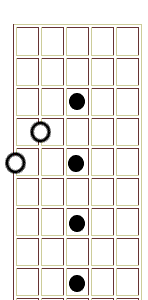
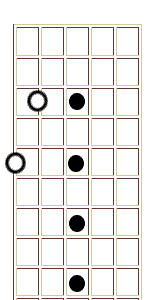
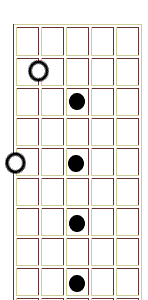
Perfect 4th-All 6 Strings
Perfect 5th-All 6 Strings
Octave-All 6 Strings
Octaves
Open String Octaves
Use Of Octaves Example
Here is an example of real world use of octaves. This is the fiery intro to
the Jimi Hendrix classic "Fire".
Major
And Minor 3rd
The major and minor 3rd intervals are very important in music. Every chord
has one or the other (except for a few exceptions). There are two fundemental
types of chords: major and minor. The 3rd interval is what determines if the
chord is major or minor.
Listen to each interval below and hear the difference. Each interval is played
both notes separate and then both notes together. Don't click the next play
button until the previous audio has stopped playing.
Major 3rd
Minor 3rd
Can You Tell The Difference?
The major 3rd interval sounds pretty common. That's no surprise because you
hear them in all major chords and major chords are the most common chords in
music. The minor 3rd is heard in minor chords. Many people associate minor
chords (and therefore the minor 3rd interval) as a "sad" sound, or
a "blue" sound. Listen to them several times or at least untill you're
sure you can tell the difference between them.